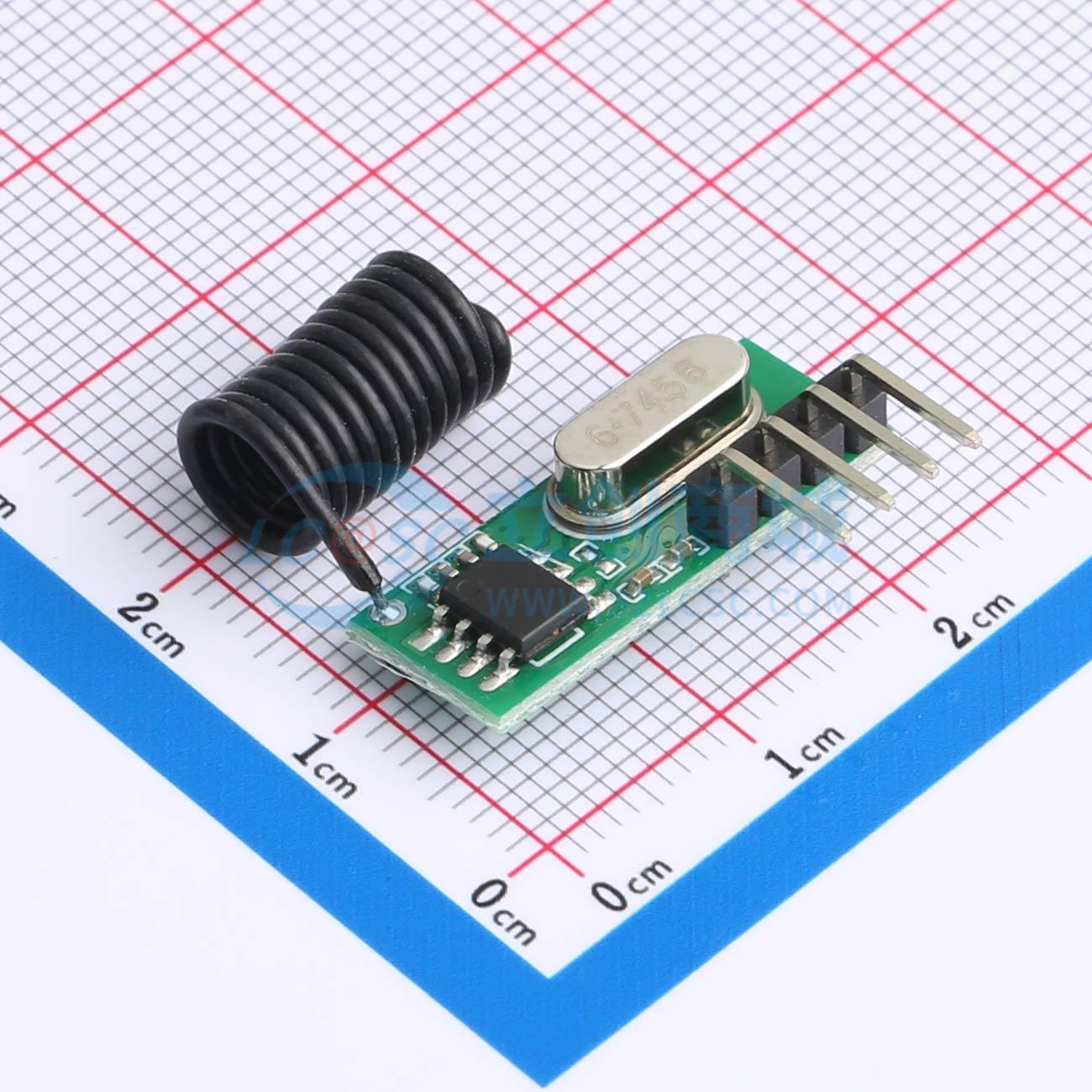
I have searched for information about the specific data format from the RX-480R (or RX480RA) module's DATA pin.
Based on the available technical specifications for this module, I was unable to find a detailed datasheet that describes the exact digital data protocol . However, the module's hardware specifications clearly indicate its communication method and define the key characteristics of the output signal.
### Summary of the DATA Pin Characteristics
The table below summarizes the confirmed technical details regarding the signal output by the RX480RA module:
| Parameter | Specification | Source / Note |
| :--- | :--- | :--- |
| **Modulation Type** | **ASK (Amplitude Shift Keying)** and **OOK (On-Off Keying)** | This is specified as the module's supported modulation methods for the incoming RF signal . |
| **Output Signal Type** | **Digital (TTL level)** | The module demodulates the received radio signal. The DATA pin provides the reconstructed digital signal. |
| **Output Voltage Level** | Approx. **3.3V to 5V** (depending on VCC) | The output level is directly related to the module's supply voltage (2.2V to 5V). It is a TTL-compatible signal. |
### Understanding the DATA output
Because the exact protocol isn't detailed in the product specifications, the following information is based on the module's hardware capabilities and standard practices for this type of component.
1. **Data is Demodulated:** The RX480RA receives an RF (radio frequency) signal modulated with ASK or OOK. Its internal circuitry demodulates this signal and outputs the resulting digital pattern directly on the DATA pin. The signal you see on the DATA pin is a raw, non-decoded stream of high and low voltage levels.
2. **"Transparent" Output:** This type of module is often referred to as a "transparent" receiver. It does not decode protocols like EV1527, PT2262, or other proprietary codes. Your microcontroller or decoder IC is responsible for interpreting the timing of the highs and lows to understand the transmitted data.
3. **Typical Data Representation:**
- **OOK:** When the transmitter is sending a "1" (carrier ON), the DATA pin on the receiver will be **HIGH** (e.g., 3.3V or 5V). When the transmitter sends a "0" (carrier OFF), the DATA pin will be **LOW** (0V).
- **ASK:** This functions similarly, where the amplitude (strength) of the carrier signal dictates the logic level.
- **Idle State:** When no signal is being received, the DATA pin will likely be in a random or high-impedance state. Therefore, it is crucial to include a decoding algorithm in your code (e.g., on an Arduino) to validate a signal's preamble and data framing before acting on it.
### How to Decode the Signal
Without an official protocol, the best way to understand the data format is to empirically analyze the output.
1. **Use an Oscilloscope or Logic Analyzer:** This is the most reliable method. Connect the probe to the DATA pin and GND.
2. **Transmit a Known Signal:** Use a 433MHz transmitter module connected to a device (like an Arduino) programmed to send a simple, repeating pattern (e.g., a 1-second HIGH, 1-second LOW).
3. **Analyze the Waveform:** On the oscilloscope, you will see the digital waveform that the RX480RA has demodulated. You can then measure the timing of the pulses.
4. **Example Decoding with a Microcontroller:**
A common technique is to measure the duration between state changes.
```cpp
// Pseudo-code example
int lastState = digitalRead(DATA_PIN);
while (digitalRead(DATA_PIN) == lastState) {
// measure the duration of the state
}
// You now know the pin was HIGH for a specific time.
// By comparing short vs long durations, you can discern logic 0 and 1.
```
### Conclusion
The specific data sheet for the RX480RA module is unavailable . Therefore, the exact data format, encoding scheme, or preamble structure cannot be provided.
However, based on the module's **ASK/OOK** modulation capability, the DATA pin will output a **digital TTL-level signal** corresponding directly to the transmitter's keyed carrier. To determine any specific protocol, you must use an oscilloscope to analyze the output or refer to the datasheet of the **companion transmitter module** you are using with it.
温馨提醒:图片仅供参考,商品以实物为准
RX480RA接收模块是UHF ASK接收解调机,支持ASK和OOK调制方式。该接收模块具有高灵敏度(-110dBm)、低功耗性能,同时具备很高的动态范围(大于60dB)。模块采用高集成度芯片,内置前端低噪声放大器,混频器,滤波器,频率合成器等电路,可以信号最大程度的优化。
- 无线电源开关、插座
- 遥控窗帘、门禁、电动车
- 安防、监控系统
- 酒店客房控制
- 智能家居产品
_________________________________________________________________________________________
0755-23311175 www.weifengheng.com
RX480RA接收模块
--------------
1、产品描述
RX480RA接收模块是UHF ASK 接收解调机,支持 ASK 和
OOK 调制方式。该接收模块具有高灵敏度(-110dBm)、低功耗性
能,同时具备很高的动态范围(大于 60dB)。模块采用高集成度芯
片,内置前端低噪声放大器,混频器,滤波器,频率合成器等电
路,可以信号最大程度的优化。
---------------
2、产品特性
• 支 持 ASK/OOK 调制方式,接收灵敏度达到-110dBm;
• 工作频率:315 MHz、433.92 MHz,带宽约±150KHz;
• 电源电压输入范围:2.2V-5.0V;
• 良好的选择性和杂散辐射抑制能力,易于通过 CE/Fcc 国际认证;
• 良好的本振辐射抑制能力,可多个接收模块一起工作(即单发多
收)且不会互相干扰,一起使用不影响接收距离;
0755-23311175 www.weifengheng.com
• 温度范围:-40-85℃ 即使在恶劣的环境温度下也能正常工作;
• 超小尺寸(可根据客户需求定制)。
----------------
3、应用范围
• 无线电源开关、插座
• 遥控窗帘、门禁、电动车
• 安防、监控系统
• 酒店客房控制
• 智能家居产品
------------------
4、封装与引脚排列
• 插针式模块–WFM480RA-A3(4)系列
0755-23311175 www.weifengheng.com
----------------
5、电气特性
0755-23311175 www.weifengheng.com
----------------
6、天线尺寸
• 普通应用型
对于一般的应用,天线可以直接采用市场通用的规格,具体如下:
315M 天线
天线线芯直径(包括外皮)1.0mm,(不包括外皮)0.5mm;
焊接端导线长度 17.5mm,天线端导线长度 9.5mm;
天线绕组直径(包括外皮)5mm;
绕组匝数 15 匝。
0755-23311175 www.weifengheng.com
433M 天线
焊接端导线长度 10mm
天线导线拉直总长度 170mm;
绕组匝数 15 匝。
• 特殊增强型
如果需要更远的通信距离,普通应用型的天线无法满足,可用增强
型天线,提高接收距离,具体如下:
315M 天线
天线线芯直径(包括外皮)1.2mm,(不包括外皮)0.5mm;
0755-23311175 www.weifengheng.com
焊接端导线长度 20mm;
天线绕组直径(不包括外皮)6.8mm;
绕组匝数 13 匝,绕组长度 23.5mm。
433M 天线
天线线芯直径(包括外皮)1.0mm,(不包括外皮)0.35mm;
焊接端导线长度 12mm;
天线绕组直径(不包括外皮)3.0mm;
绕组匝数 26 匝,绕组长度 36mm。